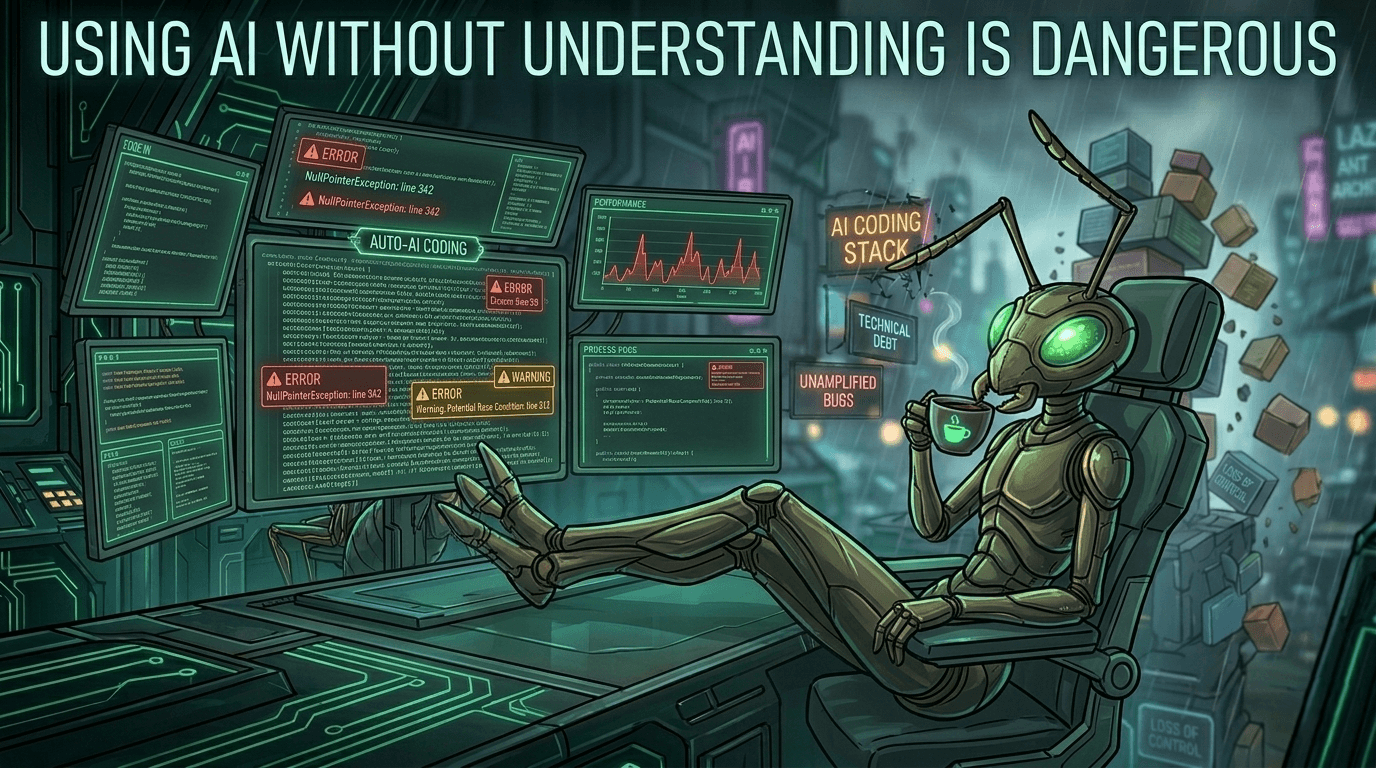
AI-assisted coding is now part of daily development workflows. While it provides speed, using AI without understanding introduces serious risks: amplified bugs, increased technical debt, and loss of engineering control. This article explores these risks and how to use AI effectively.
AI tools are now a natural part of software development. Writing a function, generating a component, or fixing a bug with a prompt is often the fastest approach. The speed is impressive. But there is a critical detail often overlooked: speed does not mean you are moving in the right direction.
Generating code with AI is easy. The real question is whether you actually understand the code you generate.
Because code you don’t understand is code you don’t control.
AI produces working solutions. Often clean-looking ones. But AI has no real intent. It generates locally optimal answers based on your prompt.
That means it can give you something that looks correct but is wrong for your overall system.
For example, when facing a performance issue, AI might suggest useMemo or useCallback. The code looks optimized, but if the real issue is incorrect state placement, the problem is only masked.
AI often treats symptoms, not root causes.
One of the biggest risks is gradually becoming a “copy-paste engineer.”
Accepting code because it works
Not questioning why it works
Not considering alternatives
Over time, this becomes a habit.
And eventually, you reach a point where you write code you don’t fully understand.
This becomes a major issue in debugging, because fixing something you don’t understand is extremely difficult.
When you introduce a bug manually, it is usually local. But with AI, incorrect patterns can spread.
AI generates patterns, and you may unknowingly reuse them across the codebase. Suddenly, the same issue exists in multiple places.
The result is exponential technical debt.
One of the most important aspects of engineering is control — knowing how your code behaves.
With AI, that control can easily fade.
You stop deciding, AI suggests.
You stop questioning, you accept.
You stop designing, you assemble.
This gives short-term speed, but weakens long-term engineering thinking.
AI is a powerful tool when used correctly.
But its role should be clear:
It should not think for you
It should not decide for you
It should only accelerate you
A good approach:
Try solving the problem yourself first
Use AI for alternatives
Always question the output
This keeps you both fast and in control.
AI-assisted coding is the new normal. But using AI without understanding doesn’t make you faster — it makes you reach mistakes faster.
The real difference is not whether you use AI, but how you use it.
Good engineers don’t avoid AI.
But they don’t surrender to it either.
Because in the end, responsibility is still yours.
For the code you write.
And the decisions you make.