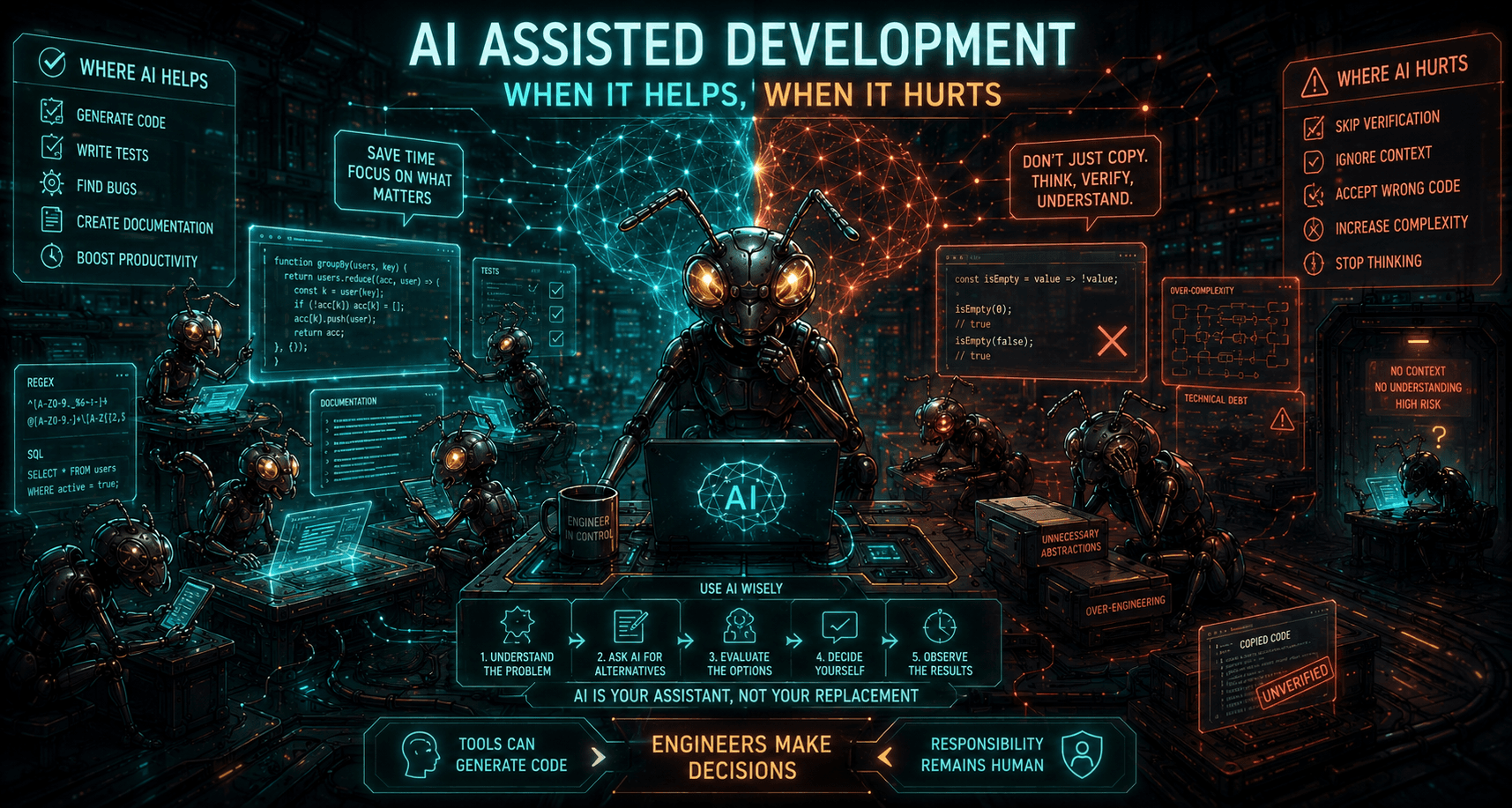
AI tools have become an essential part of modern software development. They can generate code, write tests, find bugs, and even create documentation. However, like any powerful tool, AI can create new problems when used incorrectly. In this article, we explore where AI-assisted development creates real value, where it becomes risky, and why engineers remain responsible for the decisions behind the systems they build.
Over the past few years, one of the biggest shifts in software development has been the adoption of AI tools in daily workflows.
Today, most developers use AI multiple times throughout the day.
To generate code.
To write tests.
To create regular expressions.
To prepare documentation.
Sometimes even to get architectural suggestions.
As a result, two very different perspectives have emerged.
One group believes AI will completely transform software development.
Another group argues that AI-generated code is unreliable and should not be trusted.
The reality, however, lies somewhere between these two extremes.
AI is neither a magical engineer nor a useless tool.
What matters most is how it is used.
AI is exceptionally good at repetitive tasks.
Imagine you need to write a simple data transformation function like this:
Tasks like this no longer require much effort.
AI can generate a working solution in seconds.
The same applies to:
Writing unit tests
Generating mock data
Creating boilerplate code
Building regular expressions
Preparing SQL queries
Writing documentation
In these scenarios, AI can save a significant amount of time.
The common characteristic is clear:
The problem is well defined.
The solution space is limited.
The output can be easily verified.
When those conditions exist, AI becomes highly effective.
The biggest danger of AI is not that it generates incorrect code.
The real danger is accepting incorrect code as correct.
A common pattern looks like this:
Write a prompt.
Copy the generated code.
Paste it into the project.
If it runs, move on.
This approach may feel productive in the short term, but it introduces serious risks over time.
Because working code is not always correct code.
For example, AI might suggest something like:
At first glance, this looks reasonable.
However:
may produce results that are not intended.
The problem is not that the code fails.
The problem is that it succeeds while producing incorrect behavior.
And bugs like these become much more expensive when they reach production.
This is one of AI's biggest limitations.
It can analyze your code.
It can inspect your files.
But it does not understand your business as well as you do.
Consider a question like:
Should I store user data in Redux or React Context?
AI can explain the benefits and drawbacks of both approaches.
What it cannot know is:
The experience level of your team
The current structure of your project
Your organization's engineering standards
Long-term product goals
Existing technical debt
Because of this, AI recommendations should be treated as starting points.
Not decision points.
The rise of AI has made this distinction more visible than ever.
Writing code has become cheaper.
Making good decisions has not.
For example, AI can generate a component like this in seconds:
But AI cannot answer questions such as:
Where should this component live?
Should it be reusable?
Does it fit the domain boundaries?
Is it aligned with the design system?
How will it evolve over time?
This is where engineering begins.
In my opinion, the biggest risk AI introduces is not incorrect code.
It is reducing the amount of thinking developers do.
Researching problems, making mistakes, and finding solutions are essential parts of learning.
If every answer comes from AI, we risk losing one important habit:
Asking "Why?"
Why was this function written this way?
Why was this architectural decision made?
Why is one solution better than another?
AI can provide answers.
But it cannot develop curiosity or critical thinking on your behalf.
One pattern I consistently see among experienced engineers is that they do not hand their work over to AI.
They collaborate with it.
The process often looks like this:
At this point, AI is not an engineer.
It is an assistant.
An accelerator.
A second opinion.
But the steering wheel remains in the hands of the developer.
AI has already changed software development.
And it will continue to do so.
However, one thing remains unchanged:
Responsibility.
AI can generate code.
It can write tests.
It can suggest refactors.
But it cannot take responsibility for the systems that are built.
The engineers who stand out in the future will not be the ones who generate the most code with AI.
They will be the ones who can accurately evaluate the outputs AI produces.
Because the most valuable engineer is no longer the person who writes code the fastest.
It is the person who consistently makes the right decisions.