API design is often treated as a backend responsibility. But in reality, frontend teams usually pay the biggest price for poorly designed APIs. Inconsistent responses, unnecessary nesting, unclear endpoints, and unpredictable behavior significantly slow down frontend development. This article explores API design from a frontend engineer’s perspective and explains why good APIs should not only work — they should be consumable.
When working on frontend projects, some APIs feel effortless. Endpoints are predictable, response structures are consistent, and the data flows naturally into the UI.
And then there’s the opposite.
Every endpoint behaves differently.
One returns data, another returns result, another returns a raw array.
Some fields are null, some are missing entirely.
Pagination structures differ between endpoints.
Even error formats are inconsistent.
At some point, you realize something important:
You are no longer building features. You are managing the API.
And usually, frontend teams carry the biggest burden of bad API design.
One of the most common problems in API design is building APIs entirely around backend logic.
Database relationships are exposed directly in responses. Deeply nested relational structures are sent to the frontend, even when the UI does not need most of that information.
As a result, frontend developers end up writing:
Mapping layers
Defensive code
Endless null checks
Data transformations
Special-case handling
Eventually, half of the business logic migrates into the frontend.
Good API design is not just about returning data.
It is about returning consumable data.
One of the most valuable things in frontend engineering is predictability.
UI state is already complex enough. If API behavior is inconsistent, complexity multiplies.
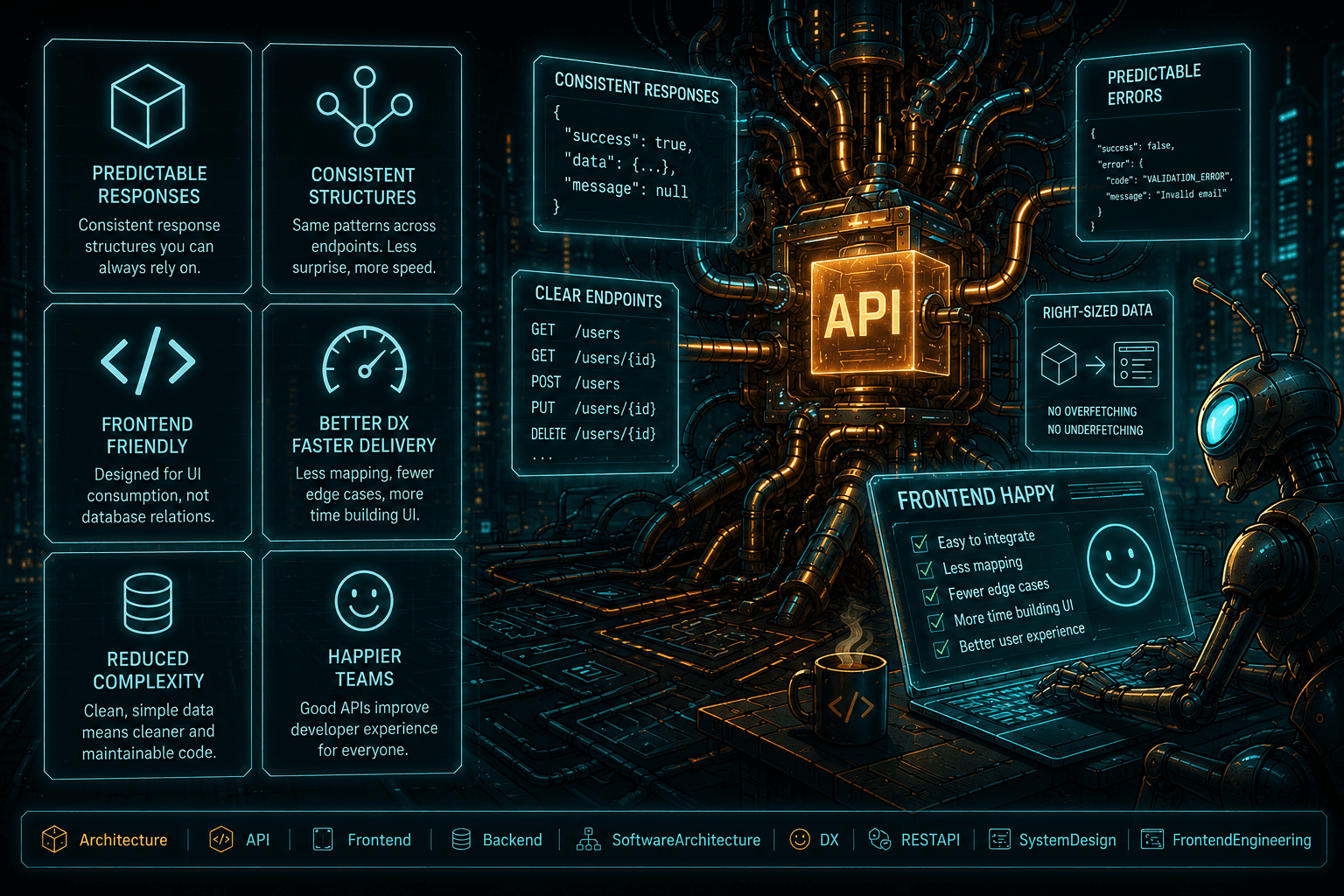
Consider a standardized response structure like:
Using a consistent response pattern across endpoints dramatically improves frontend development speed.
Because developers stop asking:
“How does this endpoint behave again?”
The same applies to error handling.
In some systems:
One endpoint returns 500
Another returns 200 + error
Another returns plain strings
Another uses different field names
At that point, the real problem is not error handling — it is unpredictability.
A well-designed API reduces frontend complexity.
Poor APIs constantly force frontend developers to make additional decisions.
Patterns like:
are often symptoms of backend-driven API structures.
At that point, frontend developers are not building interfaces anymore.
They are fighting the data structure.
Good APIs think in terms of UI consumption, not database relations.
Because frontend systems render screens, not tables.
This becomes very visible in large-scale applications.
Some endpoints return excessive data.
Others return too little, forcing multiple requests for a single UI.
Both are problematic.
Imagine a product card requiring:
product
stock
pricing
campaign
from separate requests.
Now frontend complexity shifts into orchestration logic.
But the opposite extreme is also bad: returning the entire system in one massive payload.
Good API design balances both sides.
The best backend engineers are usually the ones who care about frontend problems.
Because great backend engineering is not just about building endpoints.
It is about understanding the consumer.
Questions like:
“How will frontend consume this?”
“Is this field necessary?”
“Is this naming clear?”
“Will this structure scale?”
create massive improvements in team velocity.
Many people think DX only means frontend tooling. But API design directly affects developer experience too.
Bad APIs create:
More bugs
More mapping
More edge cases
More mental load
Good APIs reduce cognitive overhead.
And honestly, this is where good engineering begins:
Not just building systems that work, but building systems that make other engineers faster.
API design is not simply a backend output.
It is the communication language between frontend and backend.
The more consistent, predictable, and simple that language is, the faster teams move.
Because one of the biggest bottlenecks in frontend development is not rendering — it is fighting data structures.
Good API design directly improves frontend speed, maintainability, and overall engineering quality.