In frontend development, “Design System” and “Component Library” are often used interchangeably. However, they are fundamentally different. A component library focuses on reusable UI pieces, while a design system goes much further by defining visual language, usage principles, consistency, and cross-team standards. This article explores the real difference and why it matters.
At some point in frontend projects, the same problem appears:
As the UI grows, maintaining consistency becomes difficult.
Buttons look different across pages, modal behaviors vary, spacing values drift, and forms use inconsistent validation messages. These small differences eventually turn into chaos as the product scales.
At this stage, teams usually say:
“Let’s build a component library.”
And this is where a common misconception appears:
Thinking that a component library automatically means having a design system.
They are not the same thing.
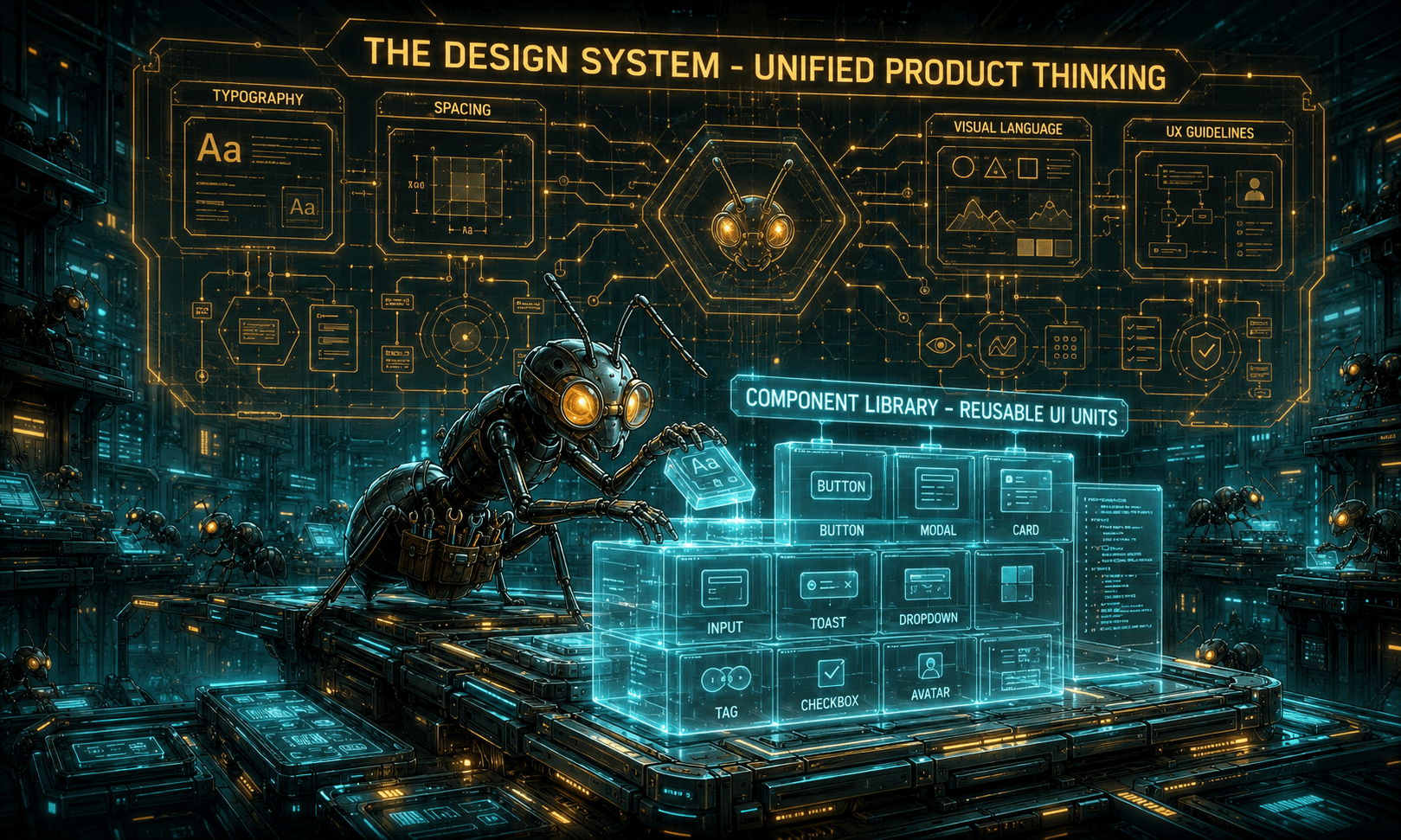
A component library is essentially a collection of reusable UI components.
For example:
Button
Input
Modal
Card
Dropdown
These shared components help reduce duplication, improve consistency, and speed up development.
This is extremely useful in large frontend projects.
But there’s an important limitation:
A component library mostly solves the code side of the problem.
A design system is not just a set of components.
It defines how the product should look, behave, and feel.
That includes:
Typography rules
Color systems
Spacing standards
Accessibility principles
Motion behaviors
UX consistency
Usage guidelines
A component library is only one part of a design system.
The difference becomes obvious as the product grows.
In small projects, reusable components may be enough. But larger teams eventually face questions like:
“Why is this button different?”
“What spacing standard are we using?”
“Why does this modal behave differently?”
“What’s our disabled state convention?”
At that point, the problem is no longer components.
It’s the system itself.
The most important part of a design system is not code standardization.
It’s decision standardization.
In large teams, the real issue is not building buttons.
It’s everyone making different decisions.
One engineer uses 12px padding
Another uses 16px
One designer changes border radius
Someone else creates different hover states
Individually, these seem minor.
Collectively, they damage product consistency.
A good design system prevents this chaos.
Another common mistake is trying to build a massive design system before it’s needed.
This often leads to over-engineering.
Good design systems don’t appear overnight.
They evolve with the product.
Patterns emerge first
Standards form later
Systems come after that
A design system is not fully designed upfront.
It is gradually discovered.
Most people focus only on developer experience.
But the real value is:
Better product consistency
Faster onboarding
Fewer design decisions
Lower maintenance costs
More predictable development
In larger teams, this impact becomes huge.
Because people stop reinventing decisions repeatedly.
Building a component library does not mean building a design system.
A component library shares UI code.
A design system shares product thinking.
One distributes components.
The other distributes consistency.
And as products scale, the difference becomes impossible to ignore.
Because sustainable frontend development is not built only with clean code —
it’s built with consistent decisions.