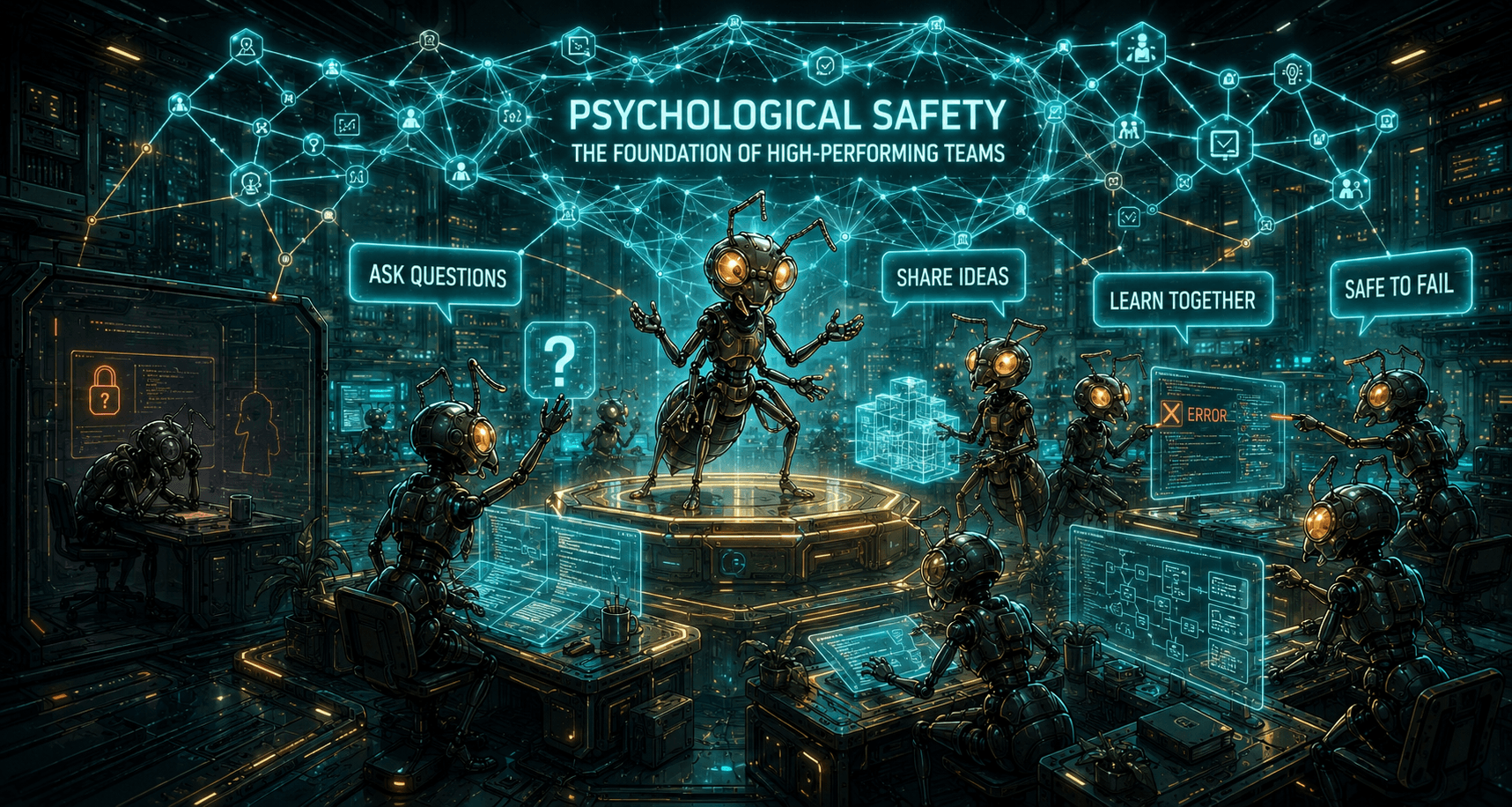
Many teams slow down not because of technical limitations, but because of communication problems. When people hesitate to ask questions, become defensive after mistakes, or avoid sharing ideas, learning starts to slow down. Psychological safety refers to an environment where team members feel comfortable asking questions, making mistakes, and expressing opinions. In this article, we explore why psychological safety is not an HR topic, but a direct engineering productivity concern.
It is difficult to explain a software team's success through technical knowledge alone.
After all, we all read similar documentation. We watch similar courses. We use similar technologies.
Yet some teams move incredibly fast while others keep circling around the same problems.
One of the biggest reasons, in my opinion, is the team's learning culture.
More specifically, how comfortable people feel while learning.
Because the moment people become hesitant to ask questions, growth starts to slow down.
And this happens much more often in engineering teams than we like to admit.
Most developers have asked themselves this at some point in their careers.
"Should I ask this question?"
"Is this too basic?"
"Does everyone know this except me?"
The moment these thoughts appear, knowledge sharing begins to slow down.
People stop asking about things they do not understand.
They continue without clarity.
And over time, small knowledge gaps turn into large problems.
Most of the time, the missing piece is not knowledge.
It is the comfort of being able to ask.
The same thing happens with mistakes.
In some teams, when someone makes a mistake, they share it immediately.
Because the goal is not to find someone to blame.
The goal is to solve the problem.
In other teams, people try to hide mistakes.
Because making a mistake means being judged.
In the first team, problems are discovered early.
In the second team, problems grow before anyone notices them.
Technically, the people involved may be equally skilled.
The culture is what makes the difference.
When knowledge sharing starts to decline, the effects are not immediately visible.
Code is still being written.
Tasks are still being completed.
Sprints continue.
But over time, invisible walls start forming inside the team.
People stop sharing what they know.
They stop asking questions.
They stop challenging ideas.
Code reviews become superficial.
Retrospectives become routine.
And eventually, the team loses its ability to learn quickly.
At that point, solving technical problems becomes much harder.
Psychological safety is often presented as an HR or management topic.
I don't think it is.
I believe it is directly related to engineering productivity.
Because engineering is fundamentally about solving problems with uncertain answers.
We work on challenges where nobody knows the perfect solution from the beginning.
In that kind of environment, if people cannot ask questions, learning slows down.
If people cannot share ideas, alternative solutions disappear.
If people are afraid of making mistakes, innovation disappears.
There is an important distinction here.
Psychological safety does not mean everyone is always right.
It does not mean nobody gets challenged.
Quite the opposite.
Ideas can be questioned.
Decisions can be debated.
Code can be criticized.
People should not be.
The focus remains on improving the solution, not attacking the person.
In my experience, this is one of the most important characteristics of healthy engineering teams.
Great teams do more than share knowledge.
They create the confidence required for learning.
Because when people feel comfortable asking questions, admitting mistakes, and presenting different ideas, growth happens naturally.
Technical skills can always be learned over time.
Building a culture that makes learning possible is much harder.
And more often than not, the thing that separates great teams from average ones is not the technology they use.
It is the environment they create.