
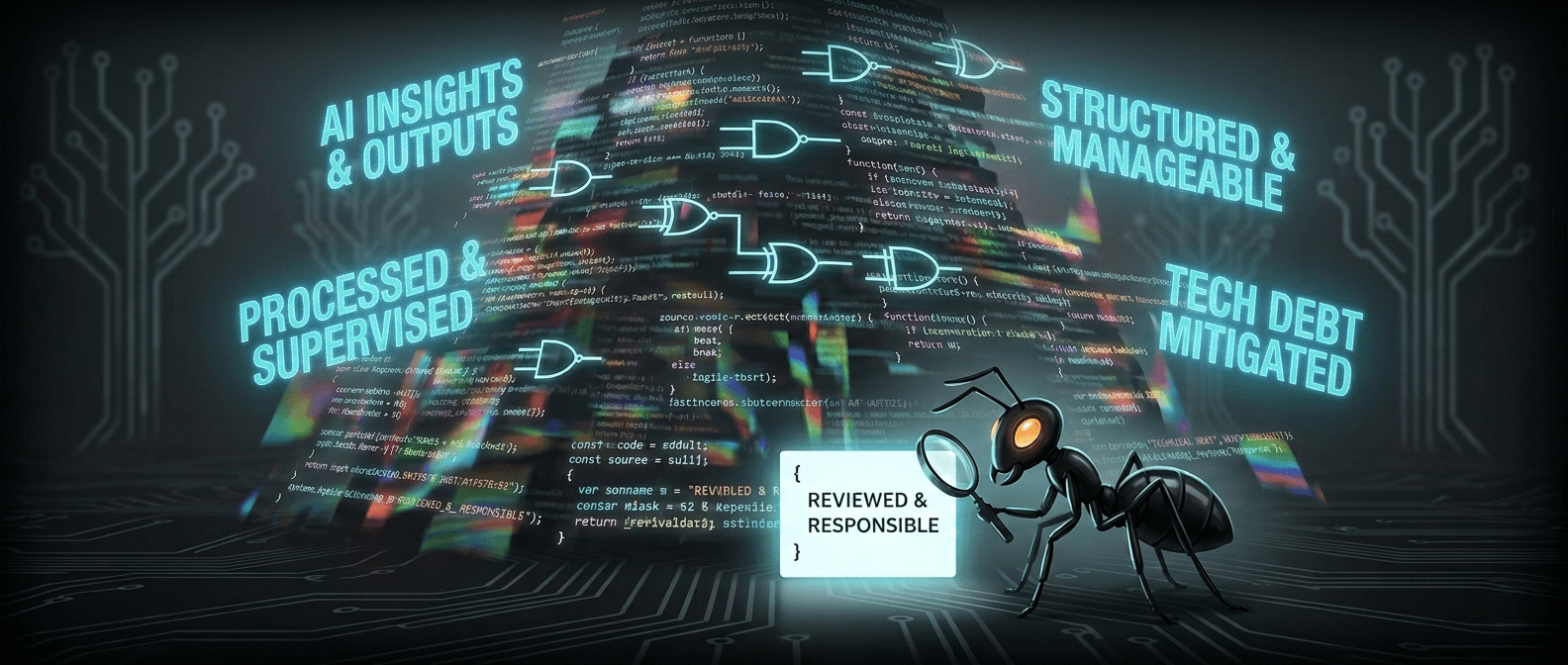
AI tools are significantly boosting developer productivity. However, speed gains come with new risks. This article explores the advantages, risks, and the "responsibility gap" of using AI in software development.
The biggest shift in the developer world recently: Coding with AI.
Today, we can generate a component. We can generate a function. Sometimes, we can even ship an entire feature. Tasks that used to take hours now take minutes.
But there is a critical point: AI writes code, but it takes no responsibility. And this difference is more important than we think.
AI is incredibly fast. But it doesn't always understand the context of the code. AI produced code:
Doesn't know the existing architecture.
Doesn't know the team standards.
Doesn't see the long-term goal of the product.
AI simply makes a prediction based on billions of lines it has seen. That’s why the output:
Might work.
But might not be maintainable.
Most AI-generated code works fast in the short term, but generates technical debt in the long run.
Unnecessary abstractions.
Overly generic structures.
Needless complexity.
AI generally produces "working" solutions. But not every working solution is a good solution. This is where the difference between levels comes in:
Junior developer: Says "it works."
Senior developer: Asks "what happens in the long run?"
Generating code without writing it has become easy. But using it without understanding it is even easier. This situation:
Extends debugging time.
Makes it impossible to understand the root cause of an error.
Grows technical debt silently.
After a while, the project reaches a point where: No one knows who wrote it, no one knows why it was written, and it becomes too risky to change. At that moment, the speed advantage of AI is lost.
AI is not bad. It’s the misuse that is risky. In a proper engineering discipline, AI:
Reduces boilerplate.
Provides alternative solutions.
Speeds up documentation.
AI doesn't replace the developer; it turns the developer into a "Code Evaluator."
Now, a good developer is not just someone who writes code, but someone who ruthlessly evaluates, simplifies, and adapts the generated code to the architecture.
Lazy Ant Take: Good systems are generally not complex. They are simple, predictable, and sustainable. AI can help you build these systems. But the responsibility for that system still lies with the developer.
Conclusion: AI makes developers faster. But it can also accelerate errors. The key is not just using AI, but using it consciously.
AI writes code, but takes no responsibility. And good engineering is about taking that responsibility.