The biggest source of complexity in software projects is rarely the amount of code. More often, it comes from the growing number of business rules accumulated over time. Products that start out simple gradually evolve into rule engines as roles, subscriptions, approval workflows, organization-specific behaviors, and countless edge cases are introduced. In this article, we'll explore why this transformation is inevitable, what makes it so difficult to manage, and how engineers can design systems that remain maintainable as products grow.
When I first started developing software, I used to measure a project's complexity by the number of lines of code.
More code meant a more complicated project. More files meant higher maintenance costs. At first, that assumption felt reasonable. After all, a larger codebase usually means more responsibility.
But after working on real-world products, I realized that code itself wasn't what made projects difficult over time.
It was the rules.
The business rules that quietly accumulated as the product evolved.
Because software products never stay the way they were designed on day one. The first version is almost always simple. At that stage, you're focused on validating the product idea rather than building the perfect architecture. The priority is proving that the product solves a real problem.
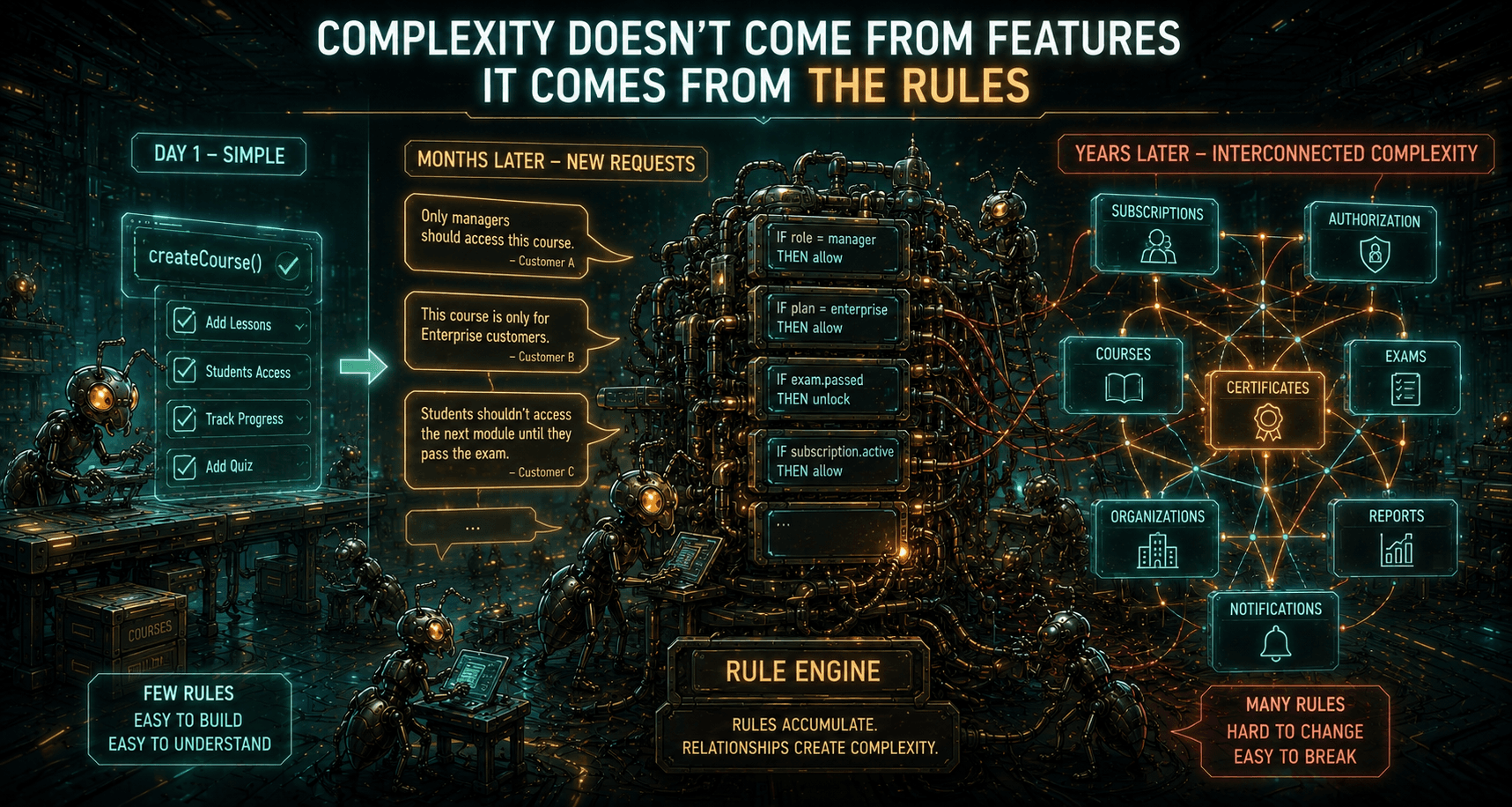
Let's take a Learning Management System (LMS) as an example.
The very first requirement might be as simple as this:
Then you add lessons.
Students can access the course.
Progress is tracked.
Maybe you introduce a small quiz.
And everything works.
At this point, the system feels clean and easy to understand because there aren't many decisions the software needs to make.
But once real customers start using the product, reality begins to shape the system.
The first customer says:
"Only managers should be able to access this course."
The next customer has a different request:
"This course should only be available for Enterprise customers."
Then another one arrives:
"Students shouldn't access the next module until they pass the exam."
Individually, none of these requests seems complicated.
A few lines of code.
A couple of additional checks.
Maybe a small database migration.
Nothing dramatic.
The interesting part is that software complexity rarely comes from individual features.
It comes from the relationships between those features.
The first rule is never the last one.
Soon new questions begin to appear.
Should certificates require an 80% passing score?
Can students retake failed exams?
Should this rule apply only to specific organizations?
Should content vary depending on the user's country?
Can enterprise customers build their own learning paths?
Can instructors modify a course after it's been published?
Every new question introduces another decision.
Not necessarily another feature.
And little by little, the product starts becoming a system whose primary responsibility is making decisions.
This is where I think many developers make the same mistake.
Every incoming request is treated as a new feature.
But in reality, most of those requests are not features at all.
They're new business rules.
That distinction may seem small at first.
Over time, it completely changes how your architecture evolves.
A certificate system isn't complicated by itself.
Neither is role-based authorization.
Subscriptions aren't inherently complex.
Progress tracking, badges, company-specific settings... none of them are difficult in isolation.
The real complexity appears when these systems begin interacting with one another.
Imagine a student wants to earn a certificate.
That decision might no longer depend only on passing an exam.
Perhaps the user must have the correct subscription plan.
The course must already be published.
A manager might need to approve it.
The student may have to complete the course before a specific deadline.
Suddenly, generating a certificate depends on multiple independent parts of the system.
Naturally, the code starts looking something like this:
The problem here isn't that the code became longer.
The real problem is that this single decision now depends on five different modules.
If one of those rules changes tomorrow, you probably won't update just this function.
You'll also need to modify reports.
Dashboards.
Mobile applications.
API contracts.
This is where complexity begins in almost every successful software product.
Frameworks will change.
Libraries will change.
Technologies will change.
But as products grow, business rules inevitably become interconnected.
And without even realizing it, every successful product slowly starts turning into a Rule Engine.
Here's the interesting part: no engineering team sits down and says,
"Let's build a rule engine today."
In fact, most teams don't even realize it's happening.
Every new requirement that arrives during a sprint feels perfectly reasonable.
"Let's add a small validation here."
"This feature should only be available for Premium customers."
"This company shouldn't have access to it."
"This behavior should be different for users in this region."
Individually, every one of these decisions makes sense.
The problem is that they accumulate over months and years.
The first rule leads to a second one.
The second introduces a third.
The third requires a fourth.
Then one day you open the codebase and realize something has changed.
You're no longer building features.
You're managing rules.
Take a simple "Publish Course" action as an example.
The first implementation is probably something like this:
Simple.
Readable.
Easy to understand.
Then the first customer comes along.
"Courses shouldn't be published until an instructor approves them."
Now the implementation changes slightly.
A few weeks later the product grows.
"Enterprise customers also require manager approval."
Then another request arrives.
"Companies with expired subscriptions shouldn't be able to publish courses."
And then another.
"If the new publishing flow feature flag is enabled, use the new process."
A few months later, the code looks something like this.
Up to this point, the code still doesn't look particularly alarming.
The real problem starts afterward.
Because these rules don't exist only here anymore.
One of the biggest challenges in real-world software is duplicated business logic.
Let's use the publishing example again.
The backend validates whether the course can be published.
The frontend needs the exact same logic just to decide whether the "Publish" button should be visible.
The dashboard applies the same rules to display publishable courses.
The mobile application repeats the same checks.
The admin panel does it again.
Before long, you've created four different implementations of the exact same business rule.
This is where technical debt quietly starts growing.
Then one day the Product Owner walks over and says a single sentence.
"Enterprise customers no longer require manager approval."
It sounds like one small requirement.
For the engineering team, however, it means:
The backend must change.
The frontend must change.
The dashboard must change.
The mobile app must change.
Test cases must be updated.
Documentation needs revision.
The requirement itself didn't become complicated.
The business rule changed.
And once business rules are scattered throughout the system, every small change becomes much larger than it appears.
Technical debt rarely starts with massive architectural mistakes.
Most of the time, it begins with small if statements.
Because whenever a new requirement appears, the fastest solution is usually to add another condition.
The next sprint:
A few weeks later:
Six months later, nobody remembers why those conditions exist anymore.
The code still works.
The tests still pass.
Nobody wants to touch it.
Because everyone knows that changing one seemingly harmless condition might unexpectedly break something in another part of the product.
To me, this is one of the scariest stages of a growing software project.
The code might still be readable.
But the reasoning behind the decisions has disappeared.
When people look at large software systems, they're usually impressed by the number of files or the size of the codebase.
I tend to look at something completely different.
How many parts of the system do I need to think about before making a single change?
If implementing one feature requires me to consider:
the authorization system,
subscription management,
notifications,
reporting,
audit logs,
the mobile application,
API contracts,
...then the problem isn't the amount of code.
The problem is that the business rules have become tightly coupled.
And that's exactly why successful products gradually evolve into Rule Engines.
Because at some point, the software is no longer responsible for displaying screens.
Its primary responsibility becomes making decisions.
Who can access what?
Who can perform which action?
Under which conditions should a feature become available?
When should something be blocked?
At that point, engineering stops being mostly about writing code.
It becomes the discipline of organizing and managing decisions.
Everything we've discussed so far might sound a little discouraging.
"So every successful product eventually becomes complicated?"
In my opinion, yes.
And I don't think that's something we can completely avoid.
If a product is growing, attracting new customers, and solving increasingly complex problems, it will naturally accumulate more business rules over time.
The goal isn't to eliminate complexity.
The goal is to make it manageable.
That's an important distinction.
Good architecture isn't the absence of complexity.
It's making sure complexity exists in the right place.
One of the biggest mistakes I see is allowing business logic to spread across the entire application.
Some rules end up in the frontend.
Others live in the backend.
Some are hidden inside API gateways.
Others find their way into SQL queries, scheduled jobs, or background workers.
Eventually, the same business rule is implemented in five different places.
That's when the real maintenance cost begins.
One thing that has changed in the way I think about software is how I see business logic.
Many teams treat it as code.
I don't think that's accurate anymore.
Business logic is knowledge.
Code is simply one way of expressing that knowledge.
Take a rule like this:
"Generate a certificate only if the student completes the course and passes the final exam."
That's not code.
That's product knowledge.
Tomorrow you might replace React with another frontend framework.
You might migrate your backend from Node.js to Go.
You might even replace your database entirely.
But that business rule will most likely remain exactly the same.
That's why business logic usually outlives technologies.
It's often the most valuable and longest-living part of the entire system.
Frameworks evolve.
Languages change.
Architectures improve.
But the core rules that define how the product behaves often survive for years.
And that's exactly why they deserve the most attention.
I see this a lot in frontend applications.
Especially in large React projects.
Over time, components stop being responsible only for rendering the UI.
They start making business decisions as well.
At first glance, nothing seems wrong with this.
Until the same condition appears in another component.
Then another page.
Then the mobile application.
A few months later, the Product Owner says:
"Managers no longer need this permission."
Now you're updating the exact same business rule in four different places.
The problem isn't React.
The problem is that the business logic has become tightly coupled with the presentation layer.
User interfaces will always change.
Business rules change too.
But the source of those decisions should remain centralized.
Whenever I'm working on a feature today, I find myself asking a simple question:
"Am I rendering an interface, or am I making a business decision?"
If the answer is the second one, there's a good chance that logic doesn't belong inside the component.
I think scalability is one of the most misunderstood concepts in software engineering.
Most people associate scalability with millions of users.
I don't.
The hardest thing to scale isn't traffic.
It's business rules.
If your user base grows, you can always add more servers.
Introduce caching.
Use a CDN.
Upgrade your infrastructure.
But when your product accumulates hundreds of business rules, there's no infrastructure upgrade that can solve that problem.
Only architecture can.
That's why I no longer think architecture exists primarily to solve today's requirements.
I think its real purpose is to absorb tomorrow's requirements without collapsing.
Whenever I implement a new feature now, I try to avoid asking only one question.
Instead of asking:
"Does this code work today?"
I also ask:
"What happens when this rule changes six months from now?"
Because in real products...
It almost always does.
When we first start building software, we tend to think products are made of components, APIs, databases, and services.
After spending enough time on real-world systems, you realize those aren't the hardest parts.
The hardest part is managing decisions.
Who can access what?
Who can modify it?
Under which conditions should something happen?
When should it be blocked?
Which customers should experience different behavior?
As those questions multiply, the product quietly transforms into something else.
A Rule Engine.
I don't think that's a sign of bad architecture.
In fact, it's usually a sign that the product is solving more real-world problems.
The challenge isn't preventing that transformation.
The challenge is recognizing it early enough to design for it.
Because every unnoticed business rule finds a place to hide.
One ends up inside a component.
Another inside an API.
Another in a database trigger.
Another inside a scheduled job.
Eventually, you're no longer building new features.
You're negotiating with decisions your product made years ago.
And to me, that's where software engineering truly begins.
Writing code is often the easy part.
The real challenge is organizing years of evolving business rules into a system that remains understandable, maintainable, and adaptable.
Frameworks will continue to change.
Programming languages will evolve.
AI will write more and more code.
New libraries will appear every week.
But twenty years ago, engineers were managing business rules.
They're still managing them today.
And they'll almost certainly be managing them twenty years from now.
Because users don't actually care about new frameworks.
They care about software that correctly reflects how their business works.
These days, when I look at a large codebase, I don't pay attention to how many components it contains.
I pay attention to how many decisions the product has to make.
Because I believe the true complexity of software isn't measured by the number of lines of code.
It's measured by the number of business rules the system is responsible for managing.