Many developers think that software engineering is primarily about writing code that works. In reality, the hardest part is rarely writing code for the first time—it's keeping that code adaptable as requirements, teams, technologies, and products continue to evolve. Change is the only constant in software development, and architecture exists to help us manage that change. In this article, we'll explore why great software isn't designed for today's requirements, but for tomorrow's inevitable changes.
One of the most common phrases you'll hear during software development is:
"Let's do it this way for now."
There's actually nothing wrong with that sentence.
No team builds the perfect system on day one. No Product Owner can predict every future requirement. And no customer truly knows what the product will look like a year from now.
The problem isn't the phrase itself.
The problem is that "for now" often becomes permanent.
One of the biggest lessons I've learned from working on real products is this: the hardest part of software engineering isn't writing code—it's being able to change that code safely months later.
Because code never stays the same.
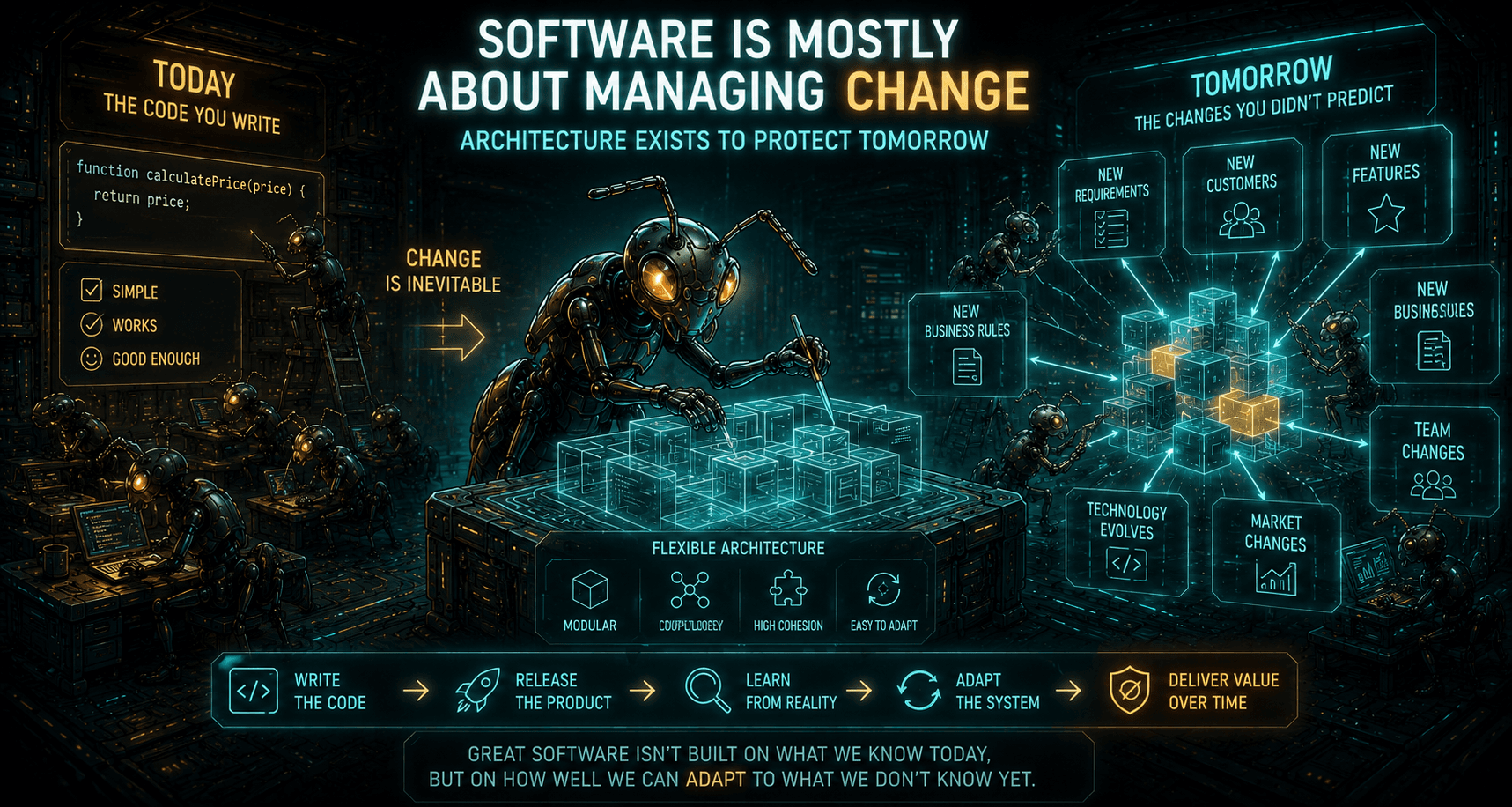
You write a simple function.
On the first day, it feels perfectly sufficient.
Then VAT is introduced.
Discounts are added.
Promotional campaigns appear.
Regional pricing becomes necessary.
Currency conversion enters the picture.
Before long, the same function is responsible for handling dozens of different scenarios.
Not because the original code was wrong.
Because the business changed.
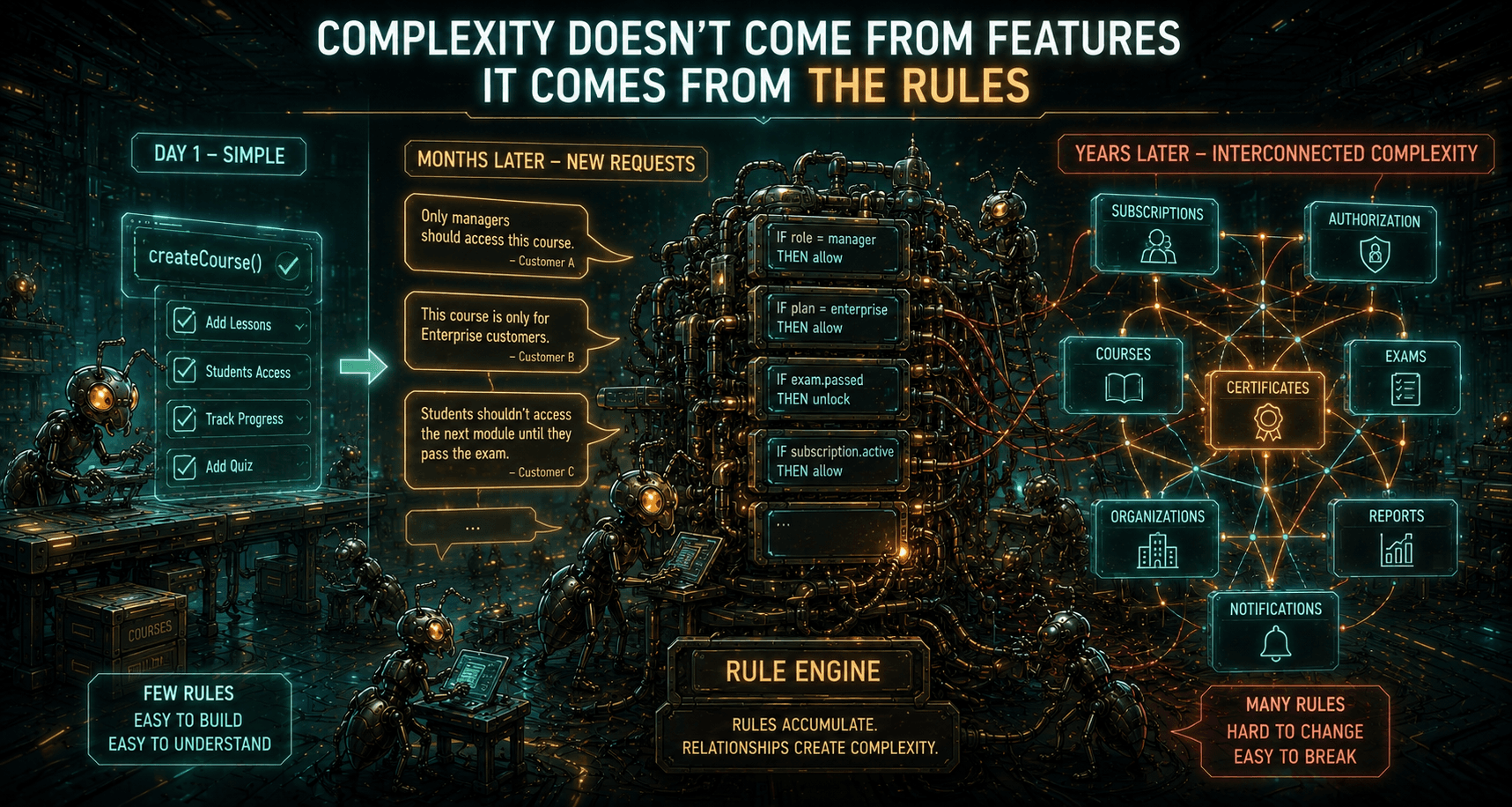
Software rarely becomes complicated because developers write bad code.
More often, complexity grows because the product evolves in ways nobody could fully predict.
One of the biggest misconceptions in software engineering is believing that requirements are stable.
They're not.
No successful product keeps the exact same requirements it had on day one.
Today, a feature may only need to be visible to administrators.
A few months later, permissions become organization-specific.
Today, one subscription plan is enough.
Tomorrow, there are Free, Pro, Enterprise, and custom plans.
Today, the application supports one language.
Next quarter, the company decides to expand globally.
Very rarely do we change code because we enjoy rewriting it.
Most of the time, we change it because the world around the product has changed.
Software isn't shaped only by code.
It's shaped by people.
There's a good chance that six months from now, you won't be the person maintaining the code you wrote today.
Maybe another developer joins the project.
Maybe the team grows.
Maybe an entirely different team takes ownership.
That's why readability isn't just a matter of style.
It's a form of communication.
Well-written code doesn't only speak to the compiler.
It also speaks to the next engineer who has to understand it.
If that person needs hours to understand a simple change, the problem usually isn't the complexity of the business.
It's the way the system communicates its intent.
Just a few years ago, many technologies that were considered modern have already been replaced by newer alternatives.
The same will happen again.
React will evolve.
Next.js will evolve.
New frameworks will emerge.
Others will disappear.
But the product will continue to exist.
Customers will still expect the same business problems to be solved.
The business rules will remain valuable long after today's technology stack has changed.
That's why I believe architecture should be built around concepts that change slowly—not around the framework that's currently popular.
Frameworks are tools.
Products are the purpose.
Architecture is often misunderstood.
Some people see it as unnecessary abstraction.
Others think it's about preparing for every possible future scenario.
I don't think it's either of those things.
Good architecture isn't about predicting the future.
It's about making future changes less painful.
We can't know which requirement will arrive next.
But we can be absolutely certain that new requirements will arrive.
That's enough reason to design systems that welcome change instead of resisting it.
Whenever I work on a new feature today, I try to ask myself a simple question:
"If I have to change this code six months from now, will I still be comfortable doing it?"
If the answer is "probably not," then the issue usually isn't the requirement.
It's the design.
Software development often looks like the process of continuously writing new code.
In reality, most of our time is spent changing existing code.
New business rules appear.
New customers arrive.
New team members join.
New technologies emerge.
Every one of those events introduces change.
And change is the one thing every software product is guaranteed to experience.
Good engineering isn't about preventing change.
It's about making sure change doesn't become a crisis.
Writing code is only the beginning.
The real challenge is building systems that remain understandable, maintainable, and adaptable as they continue to evolve.
Looking back at the projects I've worked on, the ones that stood the test of time didn't have the most sophisticated architecture.
They had the architecture that was easiest to change.
Because the biggest cost in software isn't the first implementation.
It's the years of continuous change that follow.
In my opinion, great engineering isn't about predicting every future requirement.
It's about building systems that won't panic when those requirements inevitably arrive.
The best software isn't the one that never changes.
It's the one that keeps changing without falling apart.