When people think about software development, they usually think about writing code. In reality, a significant portion of engineering time is spent dealing with systems we don't own. APIs, webhooks, authentication flows, platform settings, and third-party services often become more challenging than the business logic itself. In this article, I share an experience from a recent integration project and explain why, in modern software development, connecting systems is often harder than building them.
When I first started developing software, I believed that engineering was mostly about writing code. A new feature would arrive, I'd analyze the requirements, build the necessary structures, and implement the solution. At the time, I thought the hardest problems were algorithms, architectural decisions, or performance optimizations.
After working on real-world products, I realized there was another side to software engineering. More often than not, the place where I spent the most time wasn't my own codebase. In fact, there were times when everything I had written was working perfectly, yet the product itself still wasn't.
The reason was usually third-party services.
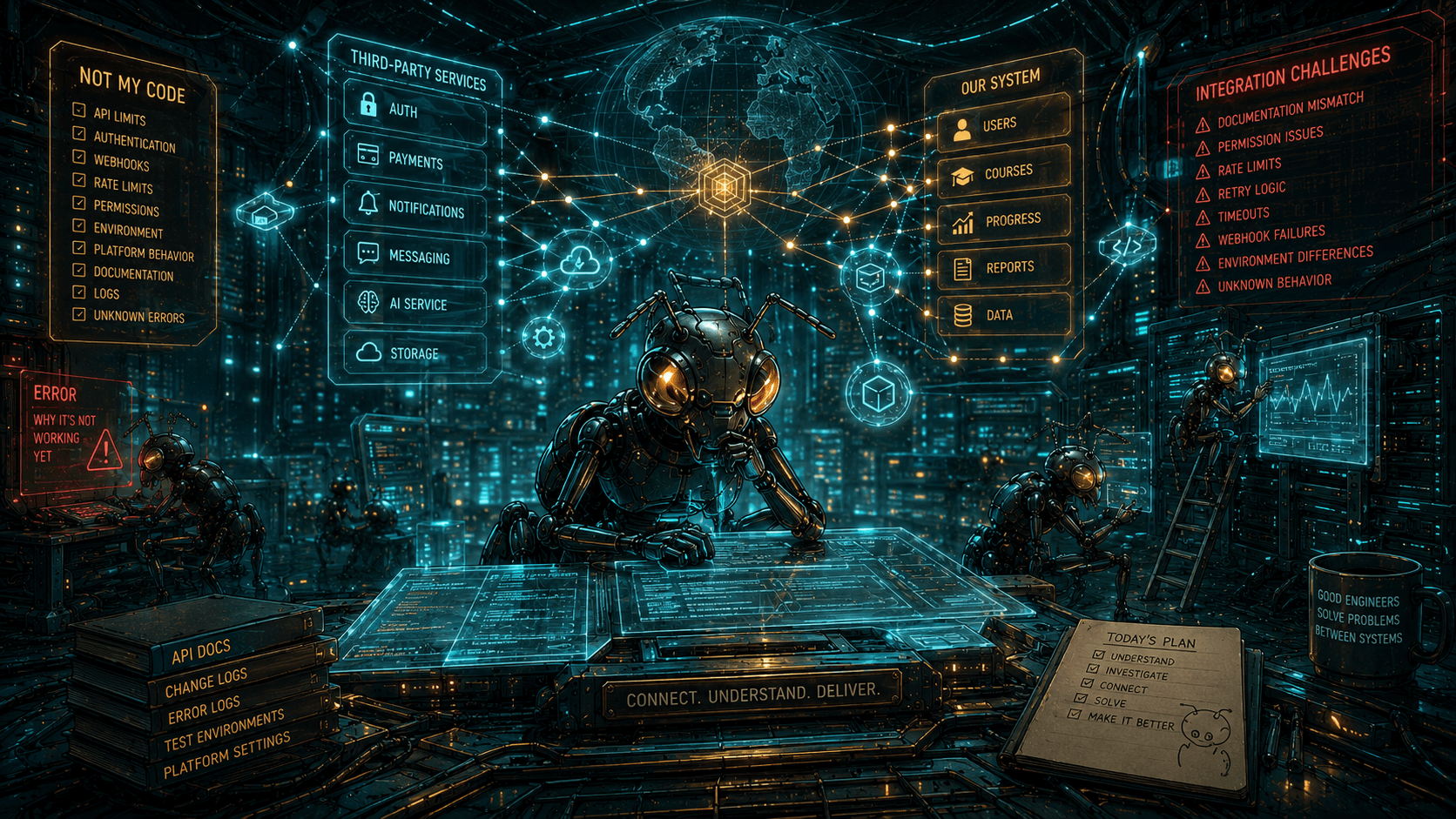
Most modern applications are actually a collection of many different systems working together. Authentication is handled by one provider, notifications come from another platform, payments are managed by a different company, and messaging is powered by yet another API. Although it feels like we're building a single application, we're constantly trying to make independent systems communicate with each other.
And that's often where the real challenge begins.
I experienced this again while working on a recent personal project. I was building a system that interacts with users through natural language, and from a technical perspective, things were progressing quite smoothly. The database was ready, the APIs were working, the AI model was producing the expected responses, and the application itself seemed healthy.
But one of the most important parts of the system simply wasn't working.
The messages I sent never reached the application.
My first reaction was probably the same as any developer's—I assumed the problem was in my own code. I checked the logs, reviewed the endpoints, redeployed the application, recreated environment variables, and tested everything repeatedly.
The interesting part was this:
The code was working.
The endpoint was working.
The database was working.
But the product wasn't.
In situations like this, our instinct is usually to write more code.
Sometimes, however, what we actually need isn't new code—it's to start looking for the problem in the right place.
After spending enough time investigating, I realized something important.
I wasn't debugging my application anymore.
I was trying to understand the behavior of someone else's platform.
Was there a missing configuration?
Was there a hidden permission issue?
Was the test environment behaving differently from production?
Was the webhook actually being triggered?
Were the requests reaching the server at all?
None of these questions were related to my business logic.
Every single one of them belonged to the integration layer.
It reminded me that when we build software, we're not only responsible for our own code. We also need to understand how the systems around us behave.
And most of the time, those systems are completely outside our control.
Modern platforms usually provide excellent documentation, and that's incredibly valuable. However, the documented "happy path" doesn't always match what happens in real life.
Everything may look straightforward in the documentation, but in practice, you may run into permission settings, platform-specific restrictions, differences between sandbox and production environments, or unexpected behaviors that aren't immediately obvious.
Sometimes you'll spend hours reviewing your code, only to discover that the issue was caused by a single configuration option on the platform.
Sometimes you'll analyze hundreds of log entries before realizing the problem was simply a missing permission.
And sometimes, the issue disappears without changing a single line of code—just because you finally found the correct settings page.
After working on enough real projects, you eventually accept that this is simply part of the job.
I used to think integrations were relatively simple.
After all, it seemed like they were just about sending a few HTTP requests and processing the responses.
I don't see them that way anymore.
Building a reliable integration requires much more than technical knowledge. It requires understanding how another system thinks.
When does it return a response?
When does it fail silently?
How does it behave when something goes wrong?
Will a webhook be delivered more than once?
What happens after a timeout?
How does the platform react when you hit a rate limit?
Most of these questions have nothing to do with your own application.
They're about understanding the behavior of another system.
That's why I no longer see integrations as "just API calls."
I see them as learning how two completely independent systems can successfully communicate with each other.
One of the most interesting things I've noticed during these kinds of projects is that I often spend very little time actually writing code.
Instead, I spend my time reading logs.
Observing how systems behave.
Replaying requests.
Isolating different scenarios.
Trying to understand where the problem truly begins.
Because before solving a problem, you first need to understand where it actually exists.
Sometimes the code isn't wrong.
The assumption is.
And correcting the wrong assumption can require far more engineering than writing another hundred lines of code.
From the outside, software development looks like writing code.
In reality, a significant portion of modern engineering is about connecting systems.
APIs, webhooks, authentication providers, payment gateways, messaging platforms, AI services, and cloud infrastructure have become essential parts of almost every product we build.
Looking back, I realize that many of the hardest problems I've solved didn't originate from my own code.
They emerged at the boundaries between systems that I didn't control.
And I believe that's where a large part of modern software engineering truly begins.
I used to think that writing clean code was the strongest indicator of a good engineer.
I still believe it's important.
But I no longer think it's enough.
Today, being a good engineer also means understanding the systems your software depends on.
Sometimes the biggest challenge isn't an algorithm.
Sometimes it's making two systems—designed by completely different teams, with completely different assumptions—speak the same language.
And in today's software world, that's often the hardest problem of all.